
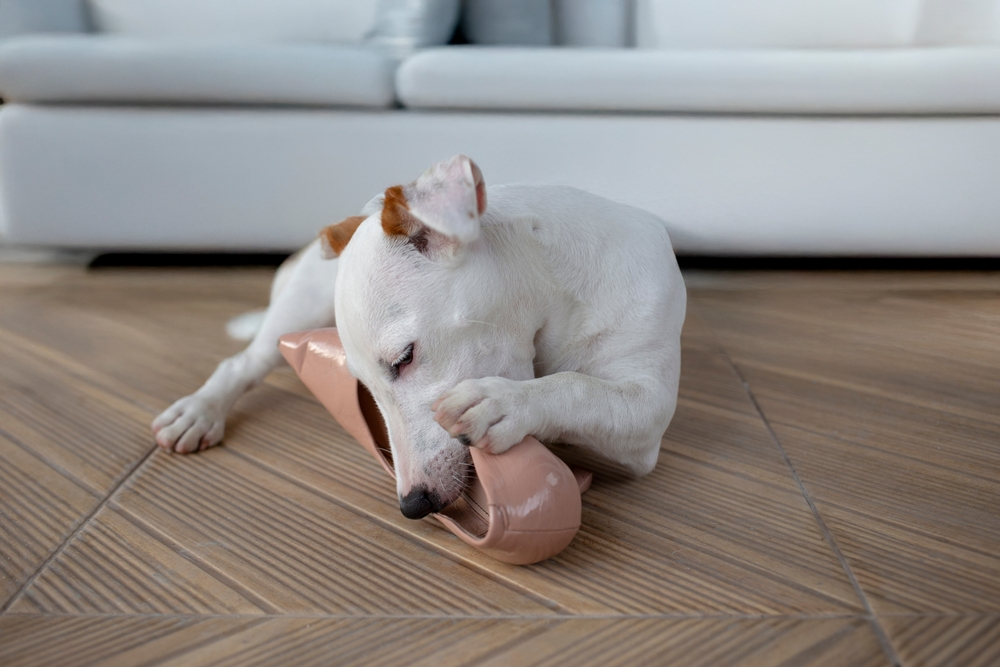
Chewing household items like shoes is one of the most common early training challenges. Puppies explore with their mouths, and without proper redirection and enrichment, valuable belongings often become targets.
Few things frustrate dog owners more than coming home to:
- Shredded toilet paper
- Chewed furniture
- Destroyed shoes
- Scratched doors
- Garbage scattered across the floor
But here’s the truth many owners miss:
Most destructive behavior is predictable — and preventable.
Dogs are not trying to be “bad.”
They are:
- Bored
- Anxious
- Understimulated
- Overstimulated
- Confused about boundaries
Preventing destructive behavior starts long before the damage happens.
Why Dogs Destroy Things
Destructive behavior typically falls into three categories:
1️⃣ Boredom
Intelligent dogs require mental engagement.
Without it, they create their own entertainment.
If you haven’t already, read:
👉 Mental Stimulation for High-Energy Dogs (Beyond Walks
Mental fatigue reduces destructive tendencies dramatically.
2️⃣ Lack of Routine
Unstructured days create uncertainty.
Uncertainty increases stress.
Stress increases impulsive behavior.
Start with:
👉 The Modern Dog Routine: How Structure Shapes Behavior
(Internal link to Article #1)
Routine eliminates guesswork for dogs.
3️⃣ Separation Stress
Dogs left alone without preparation may:
- Chew doors
- Scratch frames
- Shred paper
- Pace excessively
Gradual independence training prevents panic-driven destruction.
The Early Warning Signs
Destructive behavior rarely appears overnight.
Watch for:
- Increased restlessness
- Mild chewing escalation
- Attention-seeking behavior
- Difficulty settling
- Excessive shadowing
Small signs signal unmet needs.
Prevention Strategy #1: Controlled Freedom
Dogs should earn freedom gradually.
Instead of:
❌ Free roaming entire house immediately
Use:
✔ Crate training
✔ Exercise pens
✔ Closed-door management
✔ Supervised exploration
Freedom expands as impulse control improves.
Prevention Strategy #2: Structured Enrichment Rotation
Predictability without stimulation still creates boredom.
Rotate:
- Puzzle feeders
- Frozen enrichment toys
- Scent games
- Short training sessions
- Problem-solving activities
Enrichment prevents mental stagnation.
Again, refer to:
👉 Mental Stimulation for High-Energy Dogs
Prevention Strategy #3: Teach “Place” and Calm
Many destructive episodes start from overstimulation.
Teaching calm behaviors:
- “Place” command
- Duration stays
- Settling on mat
- Calm release cues
Builds self-regulation.
For reinforcement strategy:
👉 Positive Reinforcement in Real Life
Reward calm before chaos appears.
Prevention Strategy #4: Predictable Departures
Many owners unintentionally trigger anxiety by:
- Dramatic goodbyes
- Emotional exits
- Inconsistent leave times
Instead:
✔ Keep departures neutral
✔ Offer enrichment before leaving
✔ Practice short absences
✔ Avoid reinforcing clingy behavior
Predictability builds security.
Prevention Strategy #5: Physical + Mental Balance
Exercise without mental work leaves dogs restless.
Mental work without exercise leaves dogs wired.
Balanced daily structure includes:
- Walk
- Training
- Enrichment
- Calm downtime
Apartment owners should review:
👉 Apartment Living With Active Dogs: What Actually Works
Small spaces demand structured outlets.
Common Owner Mistakes
❌ Punishing After the Fact
Dogs do not connect punishment with past actions.
They connect it with your current tone.
Punishment after the damage only builds confusion.
❌ Too Much Freedom Too Soon
Young or newly adopted dogs need guidance.
Independence grows through consistency.
❌ Inconsistent Boundaries
If counter-surfing is ignored one day and punished the next, learning stalls.
Clarity prevents destruction.
Destructive Behavior vs. Normal Chewing
Chewing itself is not bad.
Dogs need appropriate outlets.
Provide:
- Durable chew toys
- Safe long-lasting chews
- Rotating novelty
Redirection beats restriction.
When Destruction Is Anxiety-Based
Some behaviors signal deeper stress:
- Door frame damage
- Window scratching
- Excessive drooling
- Self-harm chewing
In these cases, independence training must be gradual.
Routine becomes even more critical.
The Psychology Behind Prevention
When dogs feel:
- Mentally fulfilled
- Physically balanced
- Emotionally secure
- Clear on boundaries
Destructive behavior drops significantly.
Stress hormones decline.
Impulse control improves.
Confidence increases.
The 5-Day Prevention Reset
If minor destruction has begun:
Day 1
- Reinstate fixed routine
Day 2
- Add 10 minutes mental enrichment
Day 3
- Limit unsupervised roaming
Day 4
- Introduce structured calm training
Day 5
- Evaluate progress and adjust
Small adjustments often create rapid improvement.
Raising Destruction-Resistant Dogs
Prevention begins early.
Puppies and newly adopted dogs need:
- Structured exposure
- Gradual independence
- Calm reinforcement
- Clear household rules
For family environments:
👉 Raising a Confident Family Dog in a Busy Household
Consistency prevents confusion.
Final Thoughts
Destructive behavior is rarely random.
It is communication.
It signals:
- Boredom
- Stress
- Confusion
- Lack of outlet
Instead of reacting to damage, build prevention systems.
When routine, enrichment, reinforcement, and boundaries align:
Destruction decreases.
Confidence grows.
And your home — and dog — remain intact.